
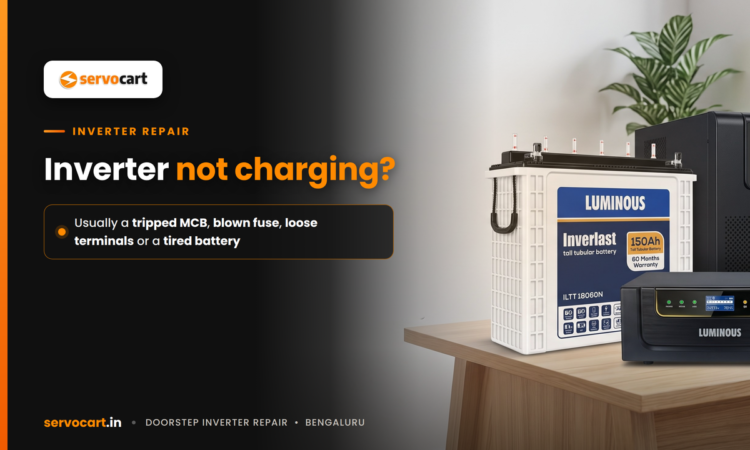
A silent inverter during a power cut is one of the most frustrating problems in any home. You flip on the backup and nothing happens, because the battery never charged in the first place. The good news is that a charging fault is often something small, a tripped switch, a loose terminal or a blown fuse. The harder faults sit inside the circuit board or the battery itself. Those are best left to a trained hand.
A professional inverter repair service in Bengaluru can trace the fault fast. This guide first explains why an inverter stops charging and the safe checks you can run yourself before booking one. Knowing the difference saves you money on a needless call-out and saves your battery from slow, avoidable damage.
Why Your Inverter Is Not Charging: Common Causes
A charging failure almost always traces back to one of a few points in the system. Power has to reach the inverter, pass through the charging circuit and arrive at a battery healthy enough to accept it. A break anywhere along that path stops the charge. The usual causes are:
- No mains supply, from a tripped MCB or a loose input connection
- A blown charging fuse on the inverter or the battery line
- Loose or corroded battery terminals blocking the current
- A weak, old or deeply discharged battery that will not take a charge
- A wrong charging mode set on the inverter panel
- A faulty rectifier, transformer or charging board inside the unit
Some of these are quick to spot and fix at home. Others need testing tools and real knowledge of the circuit. The next sections walk through both, starting with the checks anyone can do safely.
Quick Checks Before You Call an Inverter Repair Service
Before booking anything, a few simple checks rule out the easy causes. None of these need tools beyond a screwdriver and a torch. Never open the inverter casing itself, since the internal parts hold dangerous voltage even when the mains is switched off.
Check the Mains, MCB and Charging Fuse
Start at the wall. Confirm the mains socket has power and the MCB feeding the inverter has not tripped. Reset it once if it has. Many inverters also carry a small charging fuse near the battery terminals. A blown fuse cuts the charge completely while the inverter still runs the load for a while, which fools many people into thinking all is well.
Check the Battery Terminals and Water Level
Loose or dirty terminals are a very common cause. Switch everything off, then check the terminals are tight and free of the white or greenish powder that signals corrosion. A tubular or flat-plate battery of the topping type also needs its electrolyte kept above the minimum mark. Top it up with distilled water only, never tap water, which damages the plates.
The Battery Is the Most Common Culprit
When the checks above come up clean, the battery is usually the reason. Inverter batteries wear out over three to five years. The plates slowly sulphate until they can no longer hold a charge. The inverter then runs for barely a few minutes before dying.
Homes run different battery types. Flat-plate batteries are affordable and suit areas with fewer cuts, while tubular batteries last longer and handle frequent, long outages far better. Sealed maintenance-free and lithium batteries need no water topping at all. Whatever the type, a battery that reads far below its rated voltage after a full charge or drains within minutes has usually reached the end of its life. An experienced technician can tell whether the pack needs a simple inverter battery repair, a terminal clean or a full replacement.
When to Call a Professional Inverter Repair Service in Bengaluru
If the mains, the fuse and the terminals all check out and the battery is still healthy, the fault sits inside the inverter. This is the point to stop and call in a professional. The charging section holds a transformer, a rectifier and control electronics that carry high voltage. Opening the unit without training risks a shock or a far costlier fault.
What an Inverter Repair Service Checks
A qualified inverter technician works through the unit in order. They measure the mains input, then test the charging voltage at the battery, usually around 13.8 volts on float and 14.4 volts on boost for a 12 volt system. They check the specific gravity of a lead-acid cell and inspect the rectifier, the transformer and the PCB for burnt tracks or failed parts. The result is a clear verdict on whether the board needs repair, the battery needs replacing or both.
How Much Does Inverter Repair and Service Cost?
Cost depends entirely on what is wrong. A loose terminal or a blown fuse is a minor, low-cost fix. A charging board repair sits in the middle, while a new battery is usually the largest single expense. A trustworthy inverter mechanic gives an itemised quote before starting. That lets you weigh a repair against a replacement with open eyes. ServoCart shares the quote upfront at your doorstep.

Book Inverter Repair Service in Bengaluru with ServoCart
When the backup fails, you want it fixed fast and fixed right. ServoCart brings the repair to your doorstep across Bengaluru. A trained technician diagnoses the charging fault on the spot, tests the battery, gives a clear quote and carries the common spares to finish most jobs in a single visit.
A dependable inverter keeps the essentials alive through a cut, from the refrigerator in your kitchen to the security cameras at your gate. The same ServoCart teams also service your washing machine, air conditioner and water purifier across Bengaluru. One trusted team keeps the whole home running.
Conclusion
An inverter that will not charge is rarely a lost cause. A tripped MCB, a blown fuse or a loose terminal takes minutes to put right at home. A failing battery or a faulty charging board is where the skill of a technician earns its keep and protects the rest of the system from harm.
Backup gone quiet? You can book an inverter repair service with the ServoCart team and have a technician trace the fault at your doorstep, with a clear quote before any work starts.
